Layout of the City
In a rare find for the ancient world, there is an extant copy of a survey of Constantinople from 425 CE called the Notitia Urbis Constantinopolitanae. In it, an invaluable list of the urban landscape's features is provided:
5 imperial palaces
14 churches
8 public baths
3 basilicas
4 forums
2 theatres
4 harbours
4 major cisterns
322 streets
4,388 domus (likely actually insulae, apartment blocks)
52 colonnades
153 private baths
This list is one of the few things historians have left to go on nowadays, considering that much of the above doesn't survive today. None of the four thousand domus still stand. One of those 14 churches, the Church of the Holy Apostles, was rebuilt mere years after its own completion and later collapsed entirely, after which the Fatih Mosque was built in its place. It's not the only mosque to be built on top of an old church, and almost all of the churches that were still standing by the occupation of the Ottomans were converted into mosques.
Most of urban Constantinople would've been in the 13km² (5mi²) Fatih district (also known as Old Istanbul), which is currently home to almost half a million people. It's simply not feasible to proceed with any large-scale archaeology in such a densely populated area of Turkey's biggest city. One of the unavoidable stumbling blocks of studying the past is the precedence of the present, and Constantinople is no exception.
The Theodosian Walls
According to all known sources, the sickest part of Constantinople was its defensive walls. The original walls mapped out by Constantine in 324 CE were no mean feat, but the truly impressive walls were Theodosius II's.
Instead of settling for one wall, Theodosius erected two: a smaller, preliminary sort of outer wall, followed up by a much larger inner wall atop an embankment. The outer wall, about 2m (6.5ft) thick and 9m (29.5ft) tall, was a prime spot for archers to fire down from, and in the event of any forces breaching that wall, they would be caught in the 14.5m (47.5ft) space between the outer wall and the 5m (16.5ft) thick and 11m (36ft) tall inner wall, which was doubtless a very unpleasant place to be caught. Both walls were dotted with towers along their 15.7km (9.7mi) span, and they understandably impressed many a visitor coming into the city.
While unwanted guests may have struggled to penetrate the defensive walls, most people coming and going passed through one of seven gates, with the most impressive being the second iteration of the Golden Gate, which was tucked away in the southeast corner of the Theodosian walls (see picture at right).


Top: Diagram of the bipartite Theodosian Walls. Licensed for noncommercial use under Creative Commons. Bottom: A recreation of the second Golden Gate. 3D modelling by Albrecht Berger.
Monumental Buildings and Public Works
The Great Palace
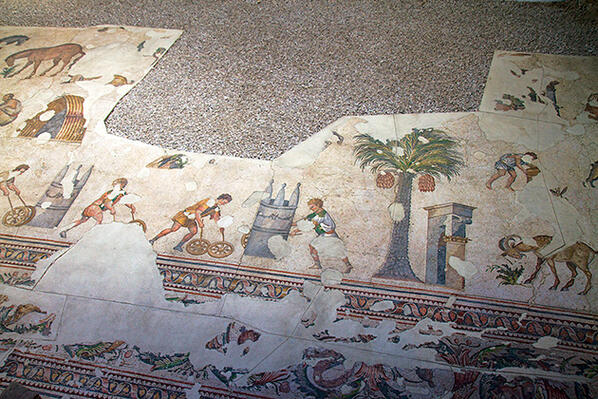
A mosaic currently housed in the Great Palace Mosaic Museum. Photo by Jürgen Horn and Michael Powell.
There wasn't a lot of room in Constantinople for villas, the traditional style of housing for Roman elites. Instead, most people lived in apartment complexes called insulae. This, of course, did not apply to emperors and their families. Of the five palaces of early Byzantine Constantinople, the most impressive was likely the Great Palace. Most of it remains a mystery to us, but from what has been excavated, it was likely the closest thing Constantinople had to a villa; it was probably a complex of buildings spread out over a lawn, decorated with intricate mosaics and full of ceremonial, formal spaces. Two nearby palaces, built a little before the Great Palace, give the best hint of what it was like: almost overly formal, to the detriment of the living spaces. This was likely inherited from earlier Roman building habits, which also favoured a rather heavy delineation between the semi-public and private parts of the home and with most space being devoted to the fomer.
The Hagia Sophia
The second iteration of the Hagia Sophia (the one prior, also named the Hagia Sophia, had been destroyed in the Nika Riots) was one of the most daring pieces of architecture in Constantinople and remains so to this day. Like most of Constantinople, however, it was a rush job with a lot of questions that would be answered along the way. For example, the vaults called for in the new design were too heavy to be supported by the foundations of its predecessor, so new foundations had to be dug. The building's shape was rectangular, which made the transition to the massive dome a uniquely tricky endeavour. This was point-based load-bearing supports on steroids: twelve piers hold up the weight of the entire dome. It was a gamble, and one that didn't pay off the first time around (see the section on lime mortar).
The initial build was completed in only six years—an unfathomably short amount of time for something of that scale, even today—and because of Justinian's haste, more lime mortar was used than brick, resulting in a building that was still slowly shifting for years after its construction. Even now, the columns in the gallery have a noticeable outward lean thanks to the downward and lateral pressure exerted by the dome.
In spite of all of this, the Hagia Sophia was and still is a marvel of both design and aesthetic. The heavy stone materials are often decorated with the most delicate of patterns, be it naturally or deliberately. The capitals of the columns are cut into intricate leafy patterns, the veined marble tiles of the floor are arranged in a way that mimics ripples in water, and sunlight streaming in through the forty windows ringing the base of the dome reflects off the floors and mosaics throughout. It is, personally speaking, one of the most moving pieces of architecture I have ever seen, and I've never even physically been there.


Left: Proconessian marble tiles in the Hagia Sophia, arranged to envoke ripples in water. Centre: Capital of a column in the Hagia Sophia. Right: The dome of the Hagia Sophia. Left and centre images by Robert Ousterhout. Right image by Christophe Meneboeuf and licensed for noncommercial use under Creative Commons.
The Hagia Sophia is the most impressive church of Constantinople and (somewhat miraculously) still stands today, but it is by no means the only surviving church. Many of them have been converted into mosques over time (see table below), but their original architecture is largely unchanged.
| Ancient Church | Modern Mosque |
|---|---|
| Church of Christ Pammakaristos | Fethiye Cami |
| Church of the Chora | Kariye Camii |
| Either the nunnery of St Theodosia or the monastery of Christ the Benefactor | Gül Camii |
| Lips monastery | Fenari Isa Camisi |
| Church of the Holy Apostles | Fatih mosque (replaced the crumbling church) |
Eleutherios Harbour
One of the first things Constantine did to attract people to his new city was establish a dole of grain, a crop that could be grown in the relatively stable hinterland of Anatolia and slightly less stable hinterland of Thrace, but not in the quantity needed. This massive uptick in demand necessitated importation on a scale that, as per usual, Constantinople's preexisting infrastructure wasn't really equipped to handle. The emperor Julian sought to rectify this with the construction of a third harbour in 362, but the largest and most important of Constantinople's four harbours was built about 30 years later: Eleutherios Harbour at the mouth of the River Lykos. Constructed by Theodosius I around 390 CE, this harbour was essential for the quantity of grain necessary to feed the urban population, most of which was sourced from Egypt. In order to meet the demand of the city's population, it was 700m (2296.5ft) wide and had almost 4km (2.5mi) of port frontage.
Water Supply
A cursory glance at a topographical map of Constantinople will show a single river running through the southwestern corner of the walled city, and a cursory image search for the River Lykos (now the Lycus river) will show why Constantinople still had a water problem. The Lykos simply did not bring in enough water fast enough, a fault cited by Warren Treadgold as the largest impediment to the city's growth, and this was a problem that was not remedied until 30 years after the city's rededication.
Cisterns
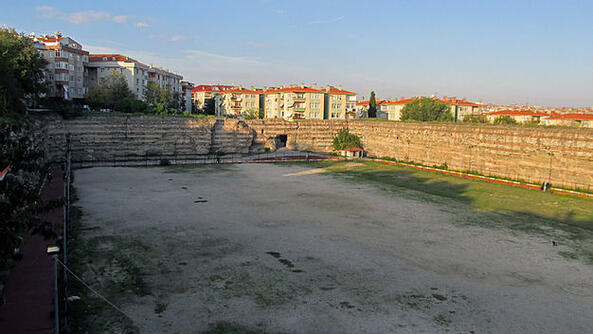
The former Fildamı Cistern (Cistern of the Hebdomon). Licensed for noncommercial use under Creative Commons.
The most common solution to this problem was the construction of cisterns. The city itself was home to over 80 covered cisterns of varying sizes, and three massive open-air ones were sprinkled in the space between Constantine's old walls and Theodosius' new ones. Each of these held over 900,000m³ (32 million ft³) of water, but the demands of the city still necessitated an additional source.
Aqueducts
The real solution to the water crisis was the addition of a new aqueduct in 363 CE by Valens. The first aqueduct to supply the city, built by Hadrian on one of his goodwill tours, was around 90km (56mi) long and had a very gentle incline, and while this was enough for Byzantium, it couldn't meet the needs of Constantinople.
To supplement it, Valens ordered the construction of a new aqueduct 20m (65.5ft) higher than Hadrian's and 270km (168mi) long, but which would grow and expand until it stretched almost 600km (373mi) into the hills of Thrace. The name "aqueduct" is actually kind of a misnomer, because almost all of the system ran underground or in canals whenever possible. The part most commonly referred to as "the Aqueduct of Valens" is a 2km (1.2mi) section in Fatih, which still stands today.